
Eastern Conference
Atlantic Division
 Boston Celtics
 Brooklyn Nets
 New York Knicks
 Philadelphia 76ers
 Toronto Raptors
Central Division
 Chicago Bulls
 Cleveland Cavaliers
 Detroit Pistons
 Indiana Pacers
 Milwaukee Bucks
Southeast Division
 Atlanta Hawks
 Charlotte Hornets
 Miami Heat
 Orlando Magic
 Washington Wizards
Western Conference
Northwest Division
 Denver Nuggets
 Minnesota Timberwolves
 Oklahoma City Thunder
 Portland Trail Blazers
 Utah Jazz
 Golden State Warriors
 Los Angeles Clippers
 Los Angeles Lakers
 Phoenix Suns
 Sacramento Kings
Southwest Division
 Dallas Mavericks
 Houston Rockets
 Memphis Grizzlies
 New Orleans Pelicans
 San Antonio Spurs


AFC
 Buffalo Bills
 Miami Dolphins
 New England Patriots
 New York Jets
 Baltimore Ravens
 Cincinnati Bengals
 Cleveland Browns
 Pittsburgh Steelers
 Houston Texans
 Indianapolis Colts
 Jacksonville Jaguars
 Tennessee Titans
 Denver Broncos
 Kansas City Chiefs
 Las Vegas Raiders
 Los Angeles Chargers
NFC
 Dallas Cowboys
 New York Giants
 Philadelphia Eagles
 Washington Commanders
 Chicago Bears
 Detroit Lions
 Green Bay Packers
 Minnesota Vikings
 Atlanta Falcons
 Carolina Panthers
 New Orleans Saints
 Tampa Bay Buccaneers
 Arizona Cardinals
 Los Angeles Rams
 San Francisco 49ers
 Seattle Seahawks


American League
 Baltimore Orioles
 Boston Red Sox
 New York Yankees
 Tampa Bay Rays
 Toronto Blue Jays
 Chicago White Sox
 Cleveland Guardians
 Detroit Tigers
 Kansas City Royals
 Minnesota Twins
 Oakland Athletics
 Houston Astros
 Los Angeles Angels
 Seattle Mariners
 Texas Rangers
National League
 Atlanta Braves
 Miami Marlins
 New York Mets
 Philadelphia Phillies
 Washington Nationals
 Chicago Cubs
 Cincinnati Reds
 Milwaukee Brewers
 Pittsburgh Pirates
 St. Louis Cardinals
 Arizona Diamondbacks
 Colorado Rockies
 Los Angeles Dodgers
 San Diego Padres
 San Francisco Giants


Soccer Formations Explained: How to Read a Starting XI Like a Coach

A starting lineup tells you which 11 players will be on the field. A formation tells you much more: where those players are likely to operate, how a team may defend, where it can create overloads, and even what kind of match the coach expects.
Before trying to decode a formation, it helps to look at the actual team sheet. Sites such as https://matchxi.com/ make it easy to check lineups and match information first. Once you know who is starting, the numbers — 4-3-3, 4-2-3-1, 3-5-2 and so on — begin to tell a story.
Understanding soccer formations does not require a coaching license. With a few basic principles, any fan can look at a starting XI and make a reasonable guess about how a team intends to play.
What Do the Numbers in a Soccer Formation Mean?
A formation describes how the ten outfield players are arranged. The goalkeeper is normally left out of the numbers.
Take the classic 4-3-3:
- 4 defenders
- 3 midfielders
- 3 forwards
A 4-4-2 has four defenders, four midfielders and two forwards.
A 3-5-2 uses three central defenders, five players across midfield and two strikers.
That sounds simple, but formations are only the starting point. Two teams using the same 4-3-3 can play completely different soccer depending on the players, their instructions and how aggressively the fullbacks or midfielders move forward.
“A formation is the map. The players’ roles and movements are the journey.”
That distinction is important. Modern teams rarely stay in one perfect shape for 90 minutes.
The Most Common Soccer Formations
Here is a quick comparison of several systems you are likely to see at professional level.
|
Formation |
Typical Strength |
Possible Weakness |
What to Watch |
|---|---|---|---|
|
4-3-3 |
Width and attacking flexibility |
Space behind advanced fullbacks |
Wingers and midfield movement |
|
4-2-3-1 |
Midfield balance |
Striker can become isolated |
Role of the No. 10 |
|
4-4-2 |
Simple structure and two forwards |
Can be outnumbered centrally |
Defensive compactness |
|
3-5-2 |
Strong central presence |
Space behind wing-backs |
Wing-back positioning |
|
5-3-2 |
Defensive stability |
Limited width when attacking |
How quickly the team changes shape |
No formation is automatically attacking or defensive. A 5-3-2 can become a 3-5-2 when the wing-backs push forward. Likewise, an aggressive 4-3-3 can quickly resemble a 4-5-1 when the wingers retreat.
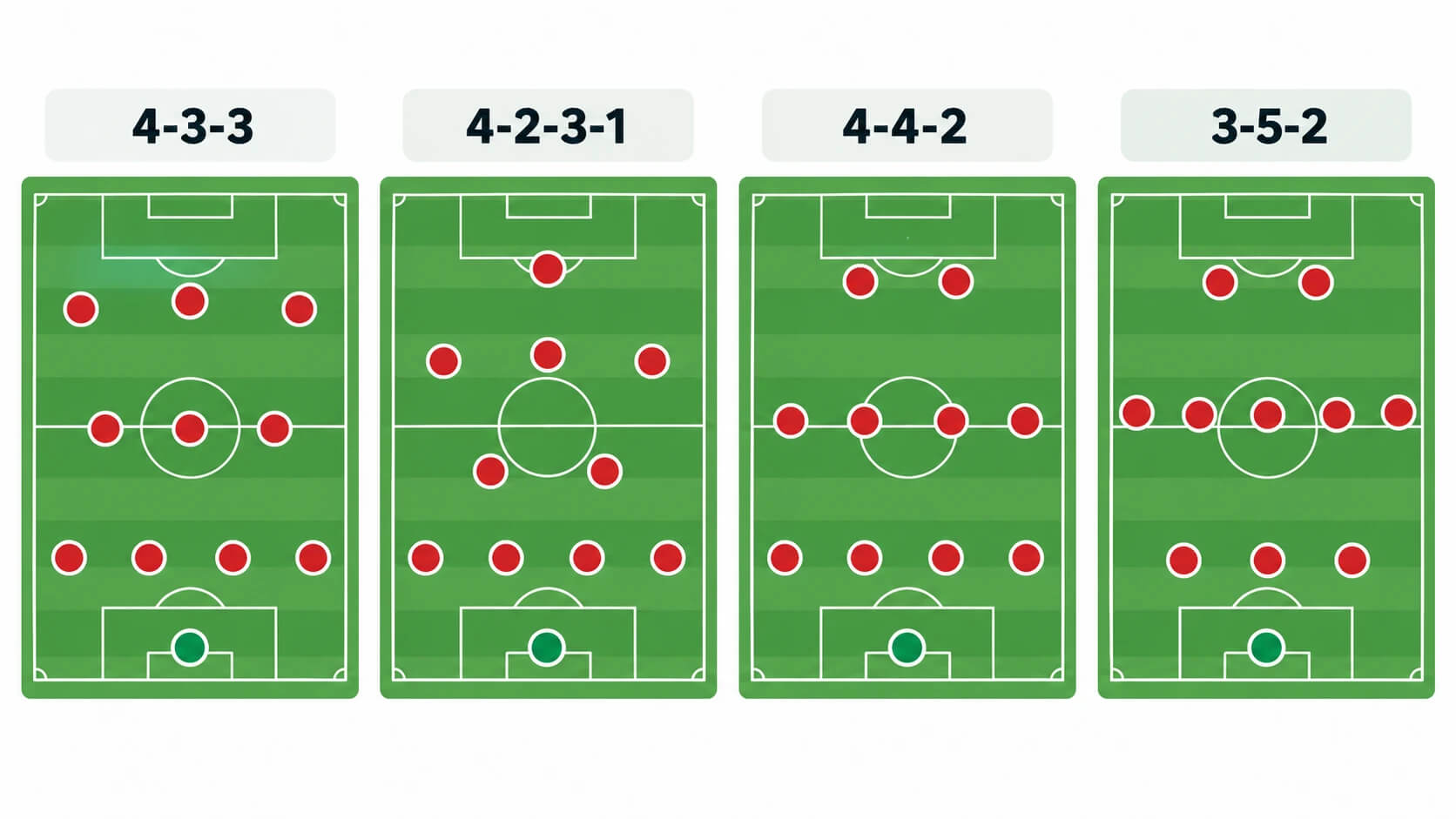
4-3-3: Width, Movement and Pressing
The 4-3-3 is one of the most recognizable soccer formations.
At first glance, the structure is straightforward: four defenders, three midfielders and three attackers. In practice, there are many variations.
One midfielder may sit deeper as a defensive midfielder while the other two move forward. Alternatively, two players can remain deeper while a third operates between midfield and attack.
The front three also tell you plenty.
If the wide players are natural wingers, the team may try to stretch the field. If they are forwards who prefer cutting inside, the fullbacks may be responsible for providing width.
When reading a 4-3-3 team sheet, ask:
- Who is the deepest midfielder?
- Are the wingers left-footed or right-footed relative to their side?
- Are the fullbacks known for attacking?
- Is the center forward a traditional striker or a player who drops into midfield?
The answers are often more informative than the formation itself.
4-2-3-1: One of Soccer’s Most Flexible Shapes
The 4-2-3-1 is especially useful because it creates several natural layers.
There are four defenders, two deeper midfielders, three attacking midfielders and one striker.
The two central players can provide defensive protection while allowing the three players ahead of them to attack more freely. The central attacking midfielder — traditionally called the No. 10 — often connects midfield with the striker.
But even here, appearances can be misleading.
One of the two deeper midfielders may regularly move forward, turning the system into something closer to a 4-3-3. A winger may move inside while a fullback overlaps. The nominal lone striker might spend much of the match dropping between the lines.
This is why reading formations is less about memorizing numbers and more about identifying relationships between players.
4-4-2: Simple Does Not Mean Outdated
Few formations are more closely associated with traditional soccer than the 4-4-2.
Four defenders sit behind four midfielders, with two strikers leading the attack.
Its greatest advantage is clarity. Players naturally occupy two compact banks of four when defending, while the two forwards can work together against opposing center backs.
The system can become difficult when facing a team with three central midfielders. Two central players may find themselves outnumbered.
Coaches solve this in different ways. One striker may drop deeper, a wide midfielder may move inside, or the team may defend in a narrower shape.
So when you see “4-4-2” on a lineup graphic, do not assume you already know exactly how the team will play.
3-5-2: Why Wing-Backs Matter So Much
The key players in a 3-5-2 are often not the three center backs or the two forwards. They are the wing-backs.
When the team has possession, the wing-backs can move high up the field and effectively become wide midfielders or even attackers.
When possession is lost, they drop alongside the three central defenders, creating a back five.
That means a 3-5-2 may look like:
3-5-2 in possession → 5-3-2 without the ball
This flexibility makes it particularly interesting to analyze.
If you want to understand how aggressive a 3-5-2 might be, look at the players selected as wing-backs. A natural winger playing there suggests very different intentions from a defensive fullback.
How to Read a Starting XI Before the Match
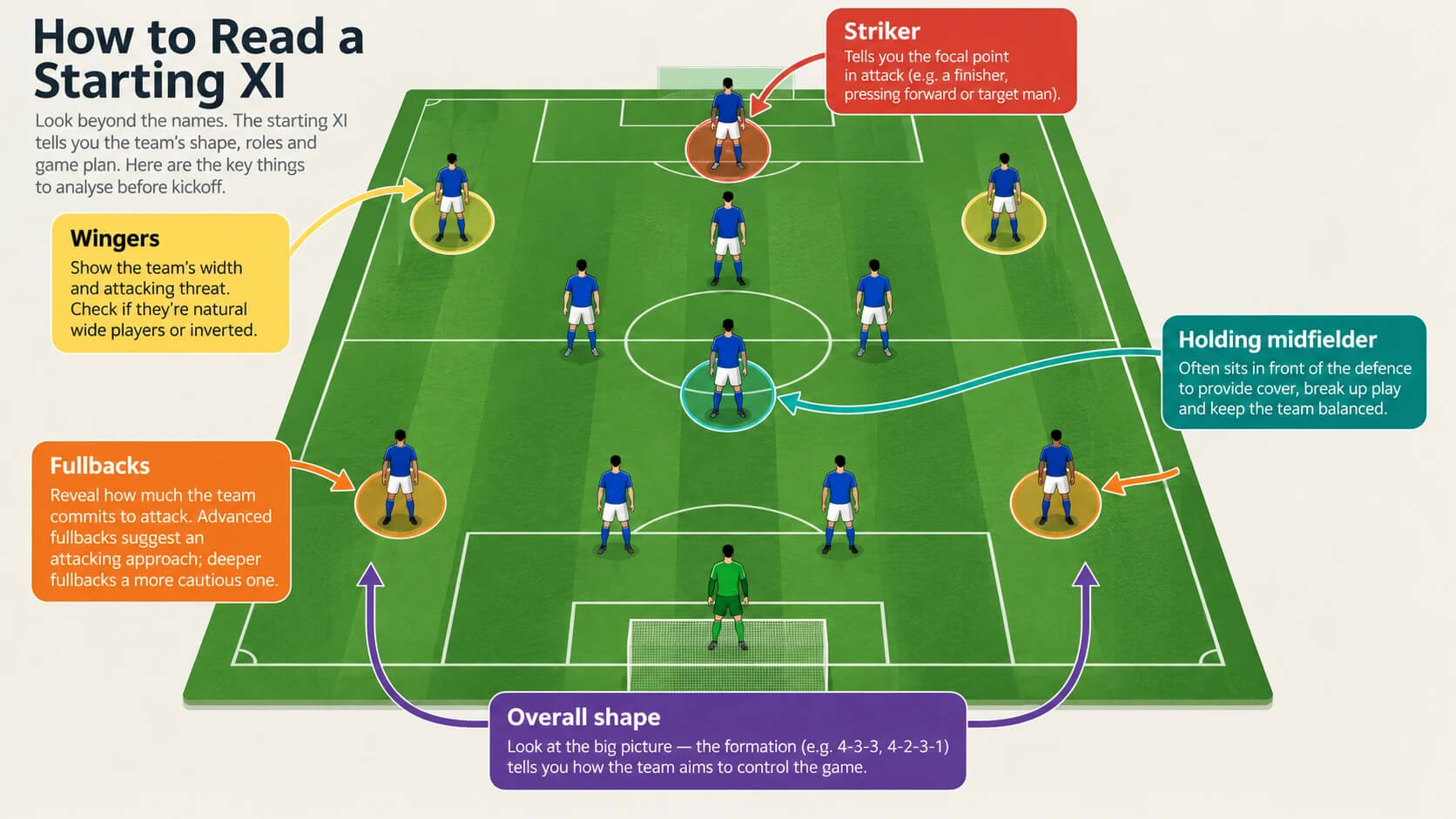
Instead of looking only at the formation graphic, use a simple five-step process.
1. Identify the natural positions
Start with what the players normally do.
If a midfielder is listed at fullback, or a winger appears as a wing-back, that may signal a tactical adjustment.
2. Find the defensive midfielder
In many modern formations, the deepest central midfielder determines the structure of the team.
A strong holding player can allow fullbacks and other midfielders to attack more aggressively.
3. Look at the wide players
Ask whether they are likely to stay wide or move inside.
This can tell you where a team expects to create space.
4. Check the striker profile
Not every center forward performs the same role.
One may attack crosses and remain close to goal. Another may drop deeper, pull defenders out of position and allow wingers to run beyond him.
5. Compare the two teams
A formation becomes more meaningful when viewed against the opponent.
A 4-3-3 facing a 4-4-2 creates different tactical questions from a 4-3-3 facing a 3-5-2.
Formation vs. Shape: Why They Are Not the Same Thing
One of the biggest mistakes fans make is treating the published formation as a fixed arrangement.
In reality, teams can have different shapes during different phases of the same match.
A side officially listed in a 4-3-3 might attack in a structure resembling a 3-2-5 if one fullback moves into midfield and the other stays deeper.
When defending, the same team might drop into a 4-1-4-1.
This means there are really several questions to ask:
- What is the team’s starting formation?
- What shape does it use in possession?
- How does it defend?
- What happens during transitions?
- Does the formation change when the team is leading or trailing?
The deeper you watch, the less important the original numbers become.
Why Formations Make Watching Soccer More Interesting
You do not need to become obsessed with tactical diagrams to benefit from understanding soccer formations.
Even basic knowledge changes the way you watch a match.
Instead of simply noticing that a winger has lots of space, you may recognize that an opposing wing-back has been pushed too high. Instead of wondering why a midfielder keeps receiving the ball freely, you might notice that the other team’s two-man midfield is being overloaded.
Before a match, check the starting XI, identify the likely formation and make a few predictions:
- Which team should have more players in central midfield?
- Where will each side get its width?
- Which fullbacks or wing-backs are likely to attack?
- Who could find space between midfield and defense?
- How might either coach change the system during the game?
Then watch to see whether those ideas actually appear on the field.
Final Thoughts
Soccer formations are best understood as a framework rather than a set of rigid instructions.
The numbers provide a useful starting point, but the real tactical picture comes from the players selected, the roles they perform and the way the team changes shape during different phases of play.
Learn to recognize the basics of the 4-3-3, 4-2-3-1, 4-4-2 and 3-5-2, and even a simple starting lineup becomes much more informative.
The next time the team sheet appears before kickoff, do not just look at the names. Look at the spaces between them. That is often where the match begins.
