
Eastern Conference
Atlantic Division
 Boston Celtics
 Brooklyn Nets
 New York Knicks
 Philadelphia 76ers
 Toronto Raptors
Central Division
 Chicago Bulls
 Cleveland Cavaliers
 Detroit Pistons
 Indiana Pacers
 Milwaukee Bucks
Southeast Division
 Atlanta Hawks
 Charlotte Hornets
 Miami Heat
 Orlando Magic
 Washington Wizards
Western Conference
Northwest Division
 Denver Nuggets
 Minnesota Timberwolves
 Oklahoma City Thunder
 Portland Trail Blazers
 Utah Jazz
 Golden State Warriors
 Los Angeles Clippers
 Los Angeles Lakers
 Phoenix Suns
 Sacramento Kings
Southwest Division
 Dallas Mavericks
 Houston Rockets
 Memphis Grizzlies
 New Orleans Pelicans
 San Antonio Spurs


AFC
 Buffalo Bills
 Miami Dolphins
 New England Patriots
 New York Jets
 Baltimore Ravens
 Cincinnati Bengals
 Cleveland Browns
 Pittsburgh Steelers
 Houston Texans
 Indianapolis Colts
 Jacksonville Jaguars
 Tennessee Titans
 Denver Broncos
 Kansas City Chiefs
 Las Vegas Raiders
 Los Angeles Chargers
NFC
 Dallas Cowboys
 New York Giants
 Philadelphia Eagles
 Washington Commanders
 Chicago Bears
 Detroit Lions
 Green Bay Packers
 Minnesota Vikings
 Atlanta Falcons
 Carolina Panthers
 New Orleans Saints
 Tampa Bay Buccaneers
 Arizona Cardinals
 Los Angeles Rams
 San Francisco 49ers
 Seattle Seahawks


American League
 Baltimore Orioles
 Boston Red Sox
 New York Yankees
 Tampa Bay Rays
 Toronto Blue Jays
 Chicago White Sox
 Cleveland Guardians
 Detroit Tigers
 Kansas City Royals
 Minnesota Twins
 Oakland Athletics
 Houston Astros
 Los Angeles Angels
 Seattle Mariners
 Texas Rangers
National League
 Atlanta Braves
 Miami Marlins
 New York Mets
 Philadelphia Phillies
 Washington Nationals
 Chicago Cubs
 Cincinnati Reds
 Milwaukee Brewers
 Pittsburgh Pirates
 St. Louis Cardinals
 Arizona Diamondbacks
 Colorado Rockies
 Los Angeles Dodgers
 San Diego Padres
 San Francisco Giants


6 Best Impact Screens for Home Golf Simulators in 2026

Most people building a home simulator spend weeks comparing launch monitors and projectors, then grab the impact screen that fits the budget they have left. That order of priorities causes problems. A grainy, noisy, or bouncy screen drags down every shot, no matter how accurate the tracking hardware behind it is. The six best impact screens for home golf simulators in 2026 below cover permanent sim rooms, shared garages, and first-time budget builds.
What Separates a Good Impact Screen From a Bad One
An impact screen in a home simulator room has to do several jobs at the same time. It needs to stop a ball leaving the clubface at well over 100 mph, hold a sharp projected image, send the ball back gently instead of firing it at the golfer, and survive thousands of full-speed strikes without tearing. Construction determines how well a screen handles all these tasks.
- Single-layer woven polyester screens are the cheapest option and stop the ball reliably, but they tend to show more texture under a projector and make a sharper crack on impact.
- Multi-layer screens stack heavy polyester surfaces, often with a spacer mesh between them, which absorbs more energy and produces a smoother projection surface.
- Fibre-bonded and ballistic-grade materials take a different route, using dense fabrics designed for heavy commercial traffic or retractable systems.
The right choice also depends on the rest of the room. Ceiling height, projector placement, and the distance between the hitting mat and the wall all shape which screen will work, so it pays to measure the space before comparing materials.
|
Screen |
Construction |
Best For |
Standout Feature |
|
GolfBays Pro+ |
Fibre-bonded material |
Permanent, high-use rooms |
Commercial-grade durability and quiet impact |
|
HomeCourse ProScreen 180 |
Ballistic-grade retractable |
Multi-use garages |
Retracts at the push of a remote |
|
SIGPRO Premium |
Three-layer spacer mesh |
Enclosure package builds |
Independently tested against competitors |
|
Carl's Place Premium |
Three-layer polyester |
Custom room dimensions |
Wide range of sizes and finishing styles |
|
Rain or Shine Tour DIY |
Ballistics-grade woven polyester |
DIY frame builds |
Vinyl border with 3/8" grommets |
|
GoSports Impact Screen |
High-density woven polyester |
First builds on a budget |
Entry price around $150 |
1. GolfBays Pro+ Impact Screen
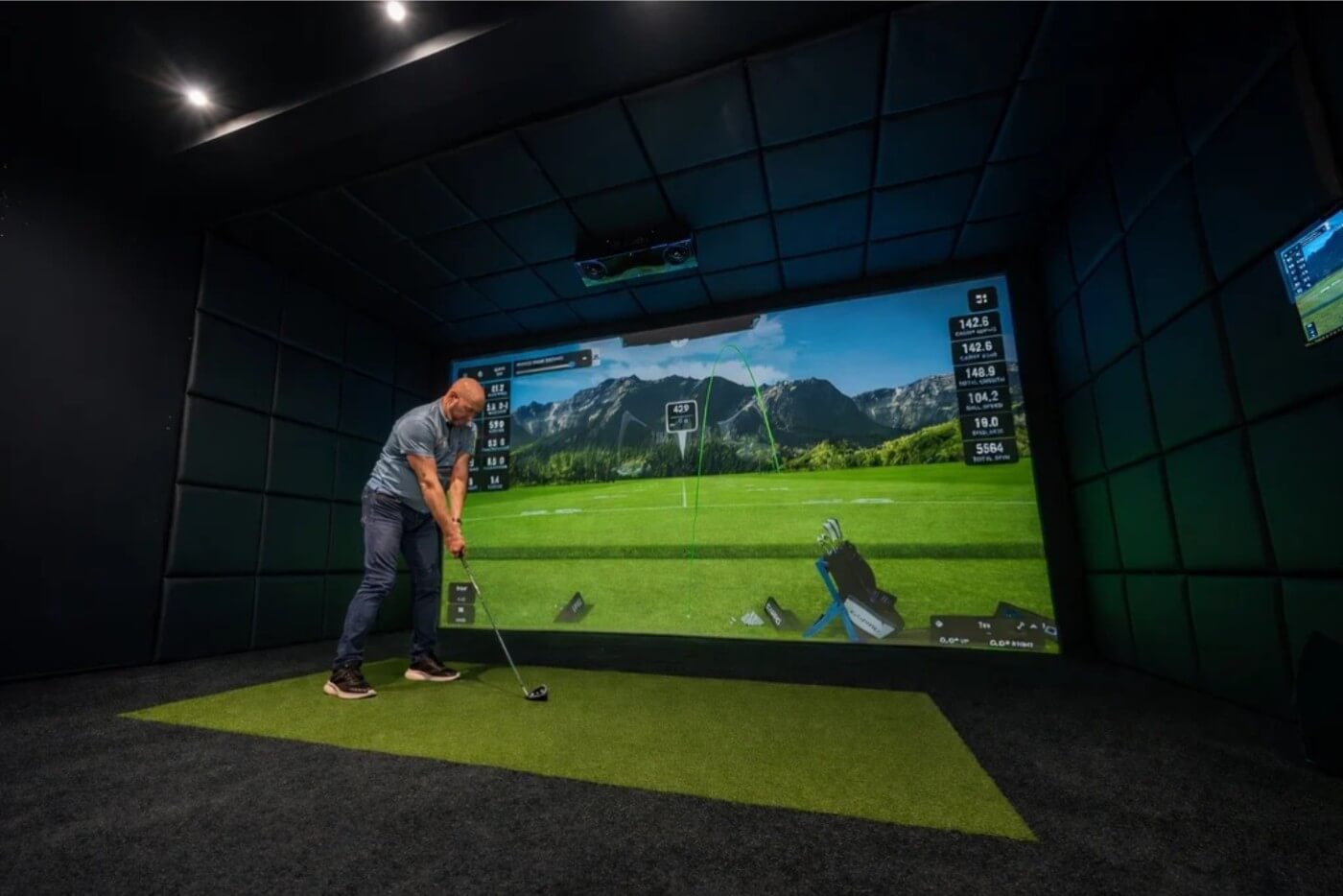
The GolfBays Pro+ earns the top spot because it handles the two hardest parts of the job at once. It holds up to heavy, repeated use while still delivering a clean, high-resolution image. That combination matters most in rooms that see daily sessions, lessons, or a steady stream of friends taking turns.
Serious home setups depend on a sharp projected ball flight to make every shot feel real. The Pro+ is a top-tier GolfBays impact screen, made from a fibre-bonded material rather than the woven polyester found in most home screens. GolfBays describes it as a commercial-grade product that stays quiet on impact and handles drives up to 200 mph. The company tests its screens in its own commercial facility with golfers of every skill level.
Sizing is one of its practical strengths. The Pro+ comes in more than two dozen standard sizes, ranging from about 7'6" wide up to 18' wide, across 4:3, 16:10, 16:9, and square formats. Custom sizes are also available for rooms that do not match a standard option.
A few details are worth knowing before buying:
- The bottom of the screen is designed to hang loose and fold underneath, which gives the material some slack on impact, so that extra length needs to be planned into measurements.
- Unlike some of GolfBays' other screens, the Pro+ does not have eyelets on all sides.
- It carries a 9-month warranty, and like every impact screen, it will eventually show wear in the main hitting zone and need replacing.
The Pro+ suits golfers building a permanent room who want a screen that behaves like the ones used in commercial bays. Its list price sits around $550, which places it alongside other premium screens rather than in the budget tier.
2. HomeCourse ProScreen 180 Retractable Screen
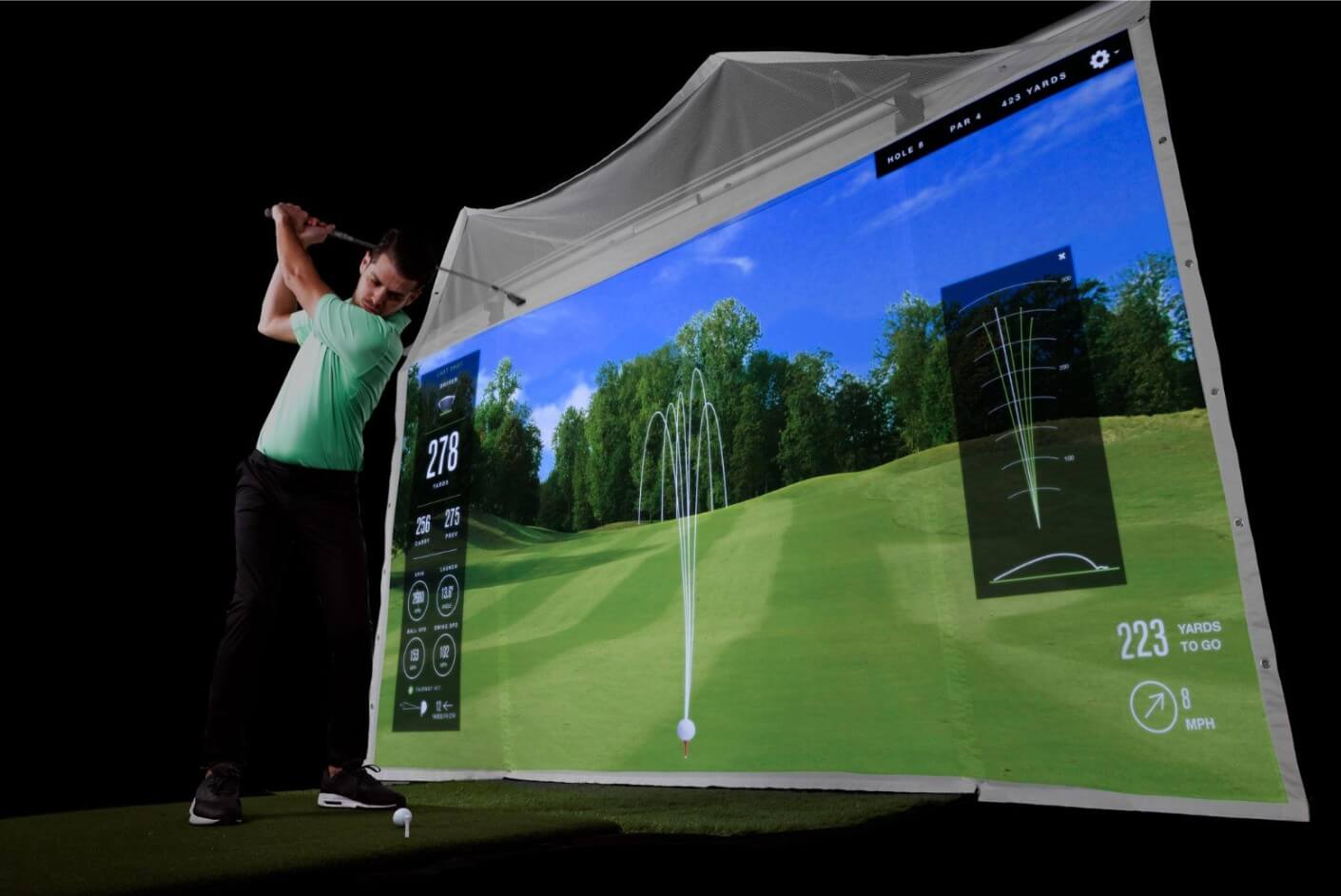
Plenty of golfers want a simulator but still need to park a car in the garage. The HomeCourse ProScreen 180 is built for exactly that problem. It mounts to a ceiling, wall, or the brand's Pro Rack, and it deploys and retracts with a wireless remote, so the space can switch between golf and everyday use within seconds.
The retractable ProScreen 180 uses a ballistic-grade screen that flexes at the bottom, letting the ball roll back towards the golfer's feet. The 180 version adds Pro Arms made from the same material as the screen, which fold out to form a projectable area about 14 feet wide and help contain mishits. A lithium-ion battery powers the system for months on a single charge, and HomeCourse lists 8 feet of clearance as the minimum mounting requirement.
This is a much larger investment than a standalone screen, since it functions as a full enclosure system rather than a replacement fabric panel. It makes the most sense for multi-use garages, offices, and family rooms. Golfers with a dedicated sim room will usually get better value and a sharper image from a fixed screen.
3. SIGPRO Premium Impact Screen
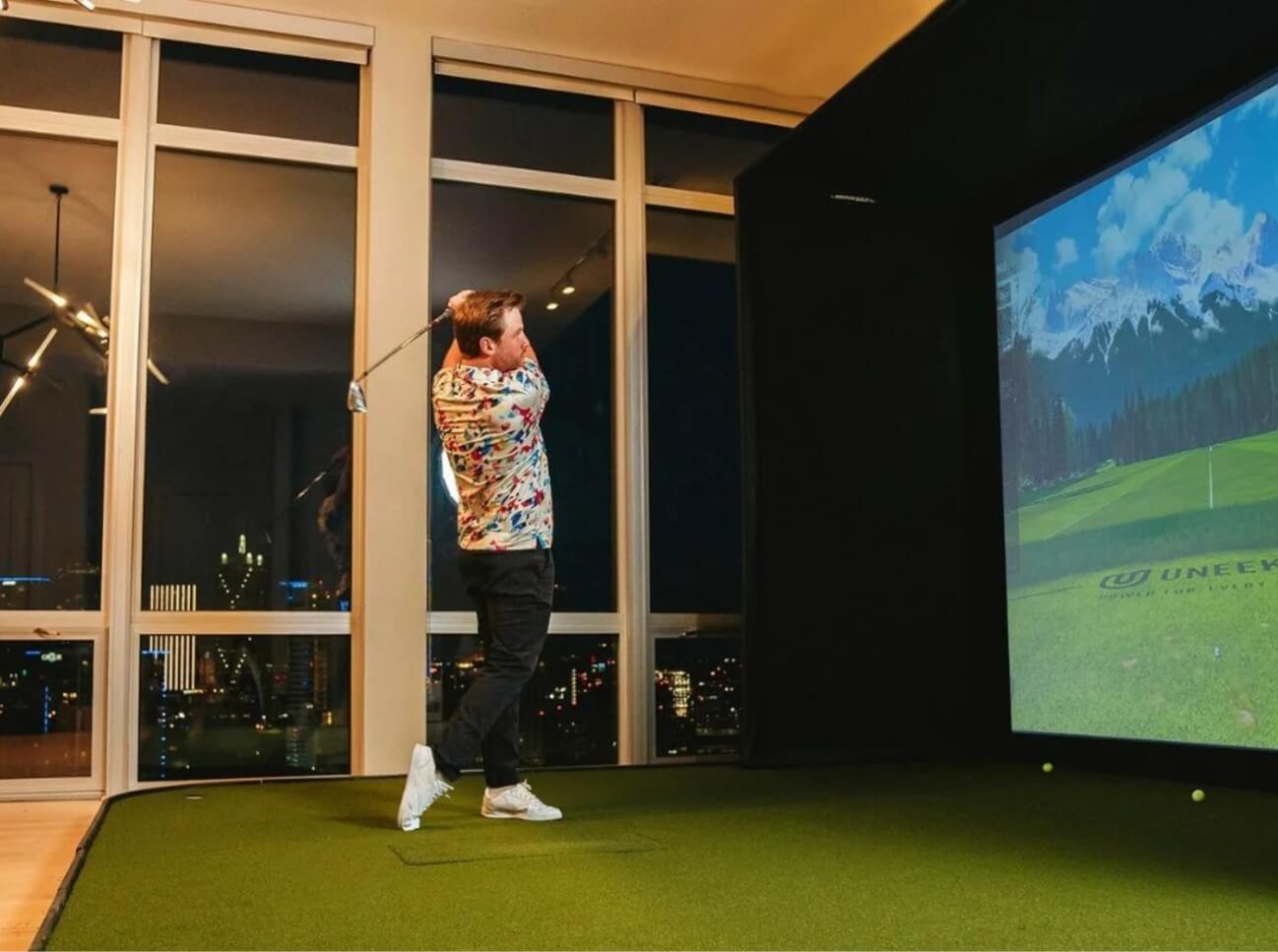
The SIGPRO Premium from The Indoor Golf Shop uses a three-layer build made from two heavy-duty polyester surfaces that sandwich vertical spacer yarns. Those spacers act as a cushion, which dampens the sound of each strike and reduces how far the ball rebounds. The smooth outer surface also cuts down the time the ball spins against the fabric, which helps extend the screen's lifespan.
Image quality is a key strength. The Indoor Golf Shop states the SIGPRO Premium screen supports a clear image up to 4K quality with minimal bleed-through and no visible grain. That level of clarity matters for setups that rely on launch monitors tracking ball speed, launch angle, and spin rate, since the projected ball flight is where those numbers come to life. The Indoor Golf Shop also points to independent head-to-head testing by MyGolfSpy, in which the SIGPRO Premium outperformed what it calls the industry's most popular impact screen.
The screen is a natural fit for golfers buying one of the brand's SIG enclosure packages, since it is designed around those frames. It comes with a one-year residential warranty covering rips and tears from ball strikes. The main limitation is that it is built around standard enclosure sizes, so rooms with unusual dimensions may be better served by a brand offering fully custom sizing.
4. Carl's Place Premium Impact Screen
Carl's Place is a long-established name in DIY simulator builds, and its Premium screen is the company's top-selling model. It is made from three layers of heavy-duty, tight-knit, impact-resistant polyester, which gives it a smooth surface for projection while also reducing noise and bounce-back. Carl's Place rates it to handle balls travelling at speeds of up to 250 mph.
The biggest advantage here is flexibility. Buyers can pick from a long list of sizes, choose between different finishing styles such as the Classic option with 2.5" black vinyl edges and grommets, and order custom dimensions for awkward rooms. Carl's Place also sells a High Contrast Gray version for rooms where ambient light washes out a white screen.
The Premium works well for golfers with non-standard wall dimensions or those building their own frame who want control over how the screen attaches. Pricing starts at around $440, depending on size and options, which places it in the same range as other premium multi-layer screens.
5. Rain or Shine Tour DIY Impact Screen
Rain or Shine Golf's Tour DIY screen targets golfers who want to build their own frame without paying top-tier prices. The screen is made from a ballistics-grade woven polyester blend with a crisp white finish, and it is edged with a vinyl-coated polyester border fitted with 3/8" grommets for hanging.
That grommet border makes installation simple. The screen works with a wide range of framing options, and Rain or Shine says most setups can be ready in a few minutes once the frame is in place. The screen is backed by a 12-month warranty.
The trade-off is projection quality at the high end. Woven single-surface materials generally show more texture than multi-layer spacer screens, which becomes more noticeable with 4K projectors and larger screen sizes. At around $449, the Tour DIY offers a good balance of durability and price for a 1080p setup or a first serious build.
6. GoSports Golf Simulator Impact Screen
The GoSports impact screen is the entry point for golfers testing whether a home simulator fits their routine. The 9-foot model measures 108 x 82.5 inches, is made from high-density woven polyester, and is sized to fit the GoSports 10 x 7 ft ELITE Golf Net. It lists at $149.99.
At that price, it meets the basic needs. It stops real golf balls, provides a workable projection surface, and mounts using the grommets built into the border.
Single-layer construction brings the expected compromises, including more noise, more bounce-back, and faster wear in the hitting zone than premium screens. It works best as a starter screen or a temporary option while a longer-term setup is planned. Golfers who practice several times a week will likely outgrow it.
How to Choose the Right Impact Screen for Your Room
Picking between these screens becomes easier when you break the decision down into a few practical factors.
Room Size and Aspect Ratio
The screen should match the projector's aspect ratio as closely as possible, whether that is 4:3, 16:10, or 16:9, so the image fills the fabric without dead space. Width matters for safety as well, since a larger hitting area gives more margin for off-center strikes. Where the room allows it, a wider screen almost always feels better to play on. The same measurements also feed into every other part of a home golf simulator setup, from launch monitor placement to the enclosure.
Bounce-Back and Safety
Bounce-back is a genuine safety issue, not only a comfort one. A review highlighted by the American Academy of Ophthalmology found that golf balls caused 72% of golf-related eye injuries and that these injuries carried a high rate of severe outcomes. Screens with thicker, multi-layer construction, loose bottom edges, and proper hitting distance all reduce how hard the ball returns. Side netting or enclosure panels add another layer of protection against mishits.
Noise Levels
Impact noise adds up over a long practice session, especially in enclosed garages and basements where sound reflects off hard walls. A sharp crack with every strike becomes tiring after an hour of practice and carries easily into the rest of the house. Quieter screen materials, such as multi-layer spacer mesh or fibre-bonded fabrics, make long sessions more comfortable and keep the rest of the household happy.
White vs Gray Screens
White screens produce the brightest image and work best in dark, controlled rooms. Gray screens trade some brightness for deeper blacks and better contrast in spaces with windows, garage door gaps, or overhead lighting. Controlling ambient light often improves the image more than switching screen colors.
Durability and Warranty
Every impact screen eventually wears out in the main hitting zone. Warranty length gives a useful signal of how confident a manufacturer is in its material, and clean golf balls and clubs extend the life of any screen. Heavy-use households should budget for replacement over time, whichever screen they choose.
Frequently Asked Questions
What is a golf simulator impact screen?
A golf simulator impact screen is a reinforced fabric panel that stops full-speed golf shots while displaying the projected image from a simulator. It is built from dense polyester, spacer mesh, or fibre-bonded materials. Ordinary projector screens and bedsheets cannot handle repeated strikes safely.
How much does a good impact screen cost?
Budget impact screens start at around $150, while premium multi-layer and commercial-grade screens commonly start between about $440 and $550, depending on size. Retractable systems and full enclosures cost considerably more. Custom sizes typically add to the price.
What size impact screen do I need?
The right size depends on room width, ceiling height, and the projector's aspect ratio. Many home builds use screens around 10 feet wide, but wider screens give more margin for mishits. Measure the full wall and the projector throw before ordering.
Is a white or gray impact screen better?
A white screen is better for dark rooms with controlled lighting because it produces a brighter image. A gray screen performs better in rooms with ambient light, since it improves contrast and deepens blacks. The decision depends on the room, not on screen quality.
How long does an impact screen last?
A quality impact screen typically lasts several years of regular home use, while budget screens may need replacing within a year of heavy practice. Lifespan depends on material, shot volume, and swing speed. Using clean balls and clubs helps slow wear in the hitting zone.
How do I reduce bounce-back from my impact screen?
Letting the bottom of the screen hang loose, choosing a multi-layer or fibre-bonded material, and keeping enough distance between the hitting mat and the screen all help reduce bounce-back. Screens that are stretched too firmly tend to rebound the ball harder. Side netting adds protection against shots that miss the center.
Can I use a regular projector screen for a golf simulator?
No, a regular projector screen is not designed to absorb golf ball impacts and will tear quickly. It can also send balls back at dangerous speeds. A purpose-built impact screen is necessary for safe indoor play.
Why is my impact screen so loud?
Loud impacts usually come from thin single-layer screens, screens stretched too tightly, or screens mounted flat against a hard wall. Leaving space behind the screen and choosing a thicker material reduces noise. Acoustic panels on nearby walls can also help.
Do impact screens come with grommets?
Many impact screens include grommets around the border for hanging with bungees or ball ties, but not all do. Some commercial and enclosure-specific screens use different attachment methods or leave the bottom edge free. Check the attachment style against the frame before buying.
Can I use a retractable screen in a garage?
Yes, retractable screens are designed for garages and multi-use rooms. They mount to the ceiling or wall and roll up when not in use, freeing the space for parking or storage. They generally cost more than fixed screens and need enough ceiling clearance for installation.
Choosing the Screen That Fits the Space
The impact screen is the one component every golfer interacts with on every swing, so it deserves as much attention as the launch monitor and projector. Permanent rooms benefit most from commercial-grade or multi-layer screens, multi-use garages are better served by retractable systems, and first-time builders can start with a budget option and upgrade later. Matching the screen to the room, lighting, and usage leads to a setup that looks good and lasts for years.
